What young people want for the world
UNESCO MGIEP Blue Dot essay contest
 Letter from the jury of the Blue Dot Essay Contest
You may have heard of the Millennium Development Goals (MDGs)—eight targets set by the UN in 2000 to define an agenda for the organization’s development efforts until 2015. Now that the deadline has passed, only very few of these targets, which include eradicating extreme poverty, reducing child and maternal mortality, and ensuring primary school education for all children, have been met.
This year, the UN will convene for its General Assembly in New York to adopt a new set of targets called the Sustainable Development Goals (SDGs), which will pave the way for all our development work over the next two decades. To hear what young people around the world have to say about their priorities for a better and more developed world, we asked them to send us an essay with their own proposals for what the new goals should focus on.
In response to the question “If you could design and implement a set of three goals that the international community—including the UN—should follow over the next 20 years, what would these goals be? Why are they important? How would you implement them?” we received more than 60 responses from participants between the ages of 16-32 from countries as far apart as India, Nigeria, Mauritius and Brazil.
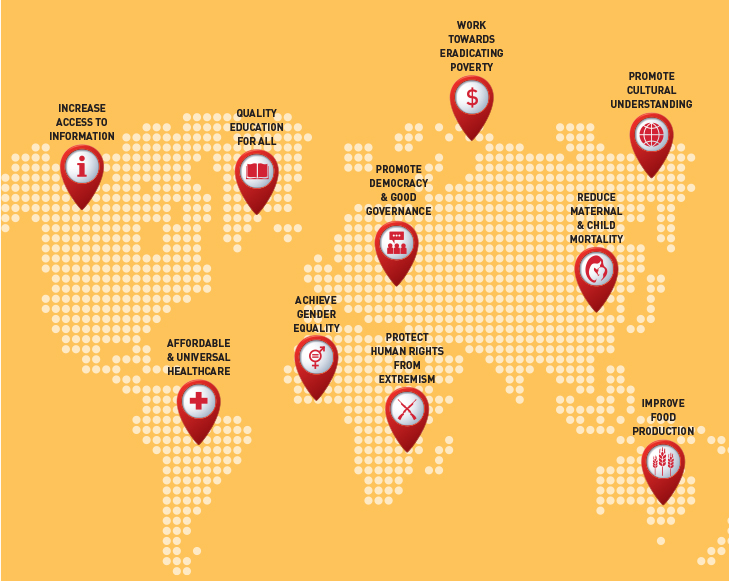
While we could only chose one winner for this issue, the wide range of responses we received showed us that many young people around the world share similar concerns about the future and that the problems they face are increasingly global in nature. Almost 40 percent of young people who submitted their essays stated that accessible quality education for all should be one of the priorities of the international community.
Eradicating poverty and offering affordable and universal healthcare came next on the list of priorities. Especially in the case of healthcare, many respondents specified that this should include providing improved health facilities and reducing maternal and child mortality rates. Others advocated for achieving gender equality, improving food production, and promoting democracy and good governance.
What appeared to be a concern among more than 10 percent of participants was the need to protect human rights from forms of extremism, including terrorism and the harmful effects of racism. Several participants also called for the inclusion of values such as promoting cultural understanding, as well as ensuring access to information and communication technologies for everyone.
The winning essayist of our contest, whose work is printed here in The Blue Dot, was chosen because of her original ideas for the future, the strength of her arguments, and her creative writing skills. We hope you enjoy reading about her plans for the future as much as we did.
The UNESCO MGIEP Team
3 dots to change the world
Evelyne Imungu Kalevera, 23 years
Student Bsc. Biochemistry, Kenyatta University. Nairobi, Kenya.
 When I was a 9-year-old girl living in Nairobi, Kenya, I always looked forward to the Sunday newspaper just so that I could fill in the ‘connect the dots’ section at the end of the children’s pullout. My enthusiasm for this simple pursuit was fueled by the desire to see the outcome, the suspense as I drew a short line from dot to dot slowly but surely seeing the progress of my work always kept me on the edge of my seat. The suspense would only subside when I was finally able to marvel at what I thought was a great work of art at the time. Generally, I no longer read the children’s section of the newspaper but I retain the knowledge that simple steps—connecting the dots—can lead to great success.
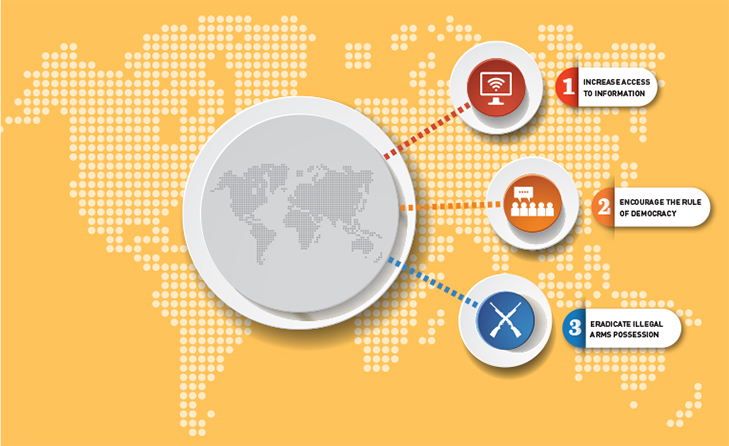
Following the United Nations Millennium Summit of 2000, the member states decided to adopt eight Millennium Development Goals (MDGs) to be achieved by 2015. By most measurements, it can be said that the majority of the member states that agreed to these MDGs have made great strides towards achieving them. Development is a relentless pursuit and, now that 2015 is here, we are sure to ask ourselves, ‘what’s next?’ Through the successful combination of deliberate and united efforts by the more than 180 member states of the United Nations, we can now proudly move on from MDGs to Sustainable Development Goals (SDGs) and the post-2015 development agenda. Our portrait of eight dots is complete and now we look to advance our efforts towards sustainable development. I now have three dots with which to change the world:
1. Increase access to information, information sharing platforms and ensure internet connectivity for all.
2. Encourage the rule of democracy and embrace the inclusion of all stakeholders during legislative discourse and ensure better incorporation of citizens in decision making at all levels.
3. Work towards eradication of illegal arms possession and trade.
The internet has made the world a smaller place as a breaking story can travel the world in minutes. You can also attain a respected degree without having to step into a classroom through the technology of distance learning. Every day sees the internet evolve further into inarguably one of the greatest tools of communication in the modern era. It is for this reason that internet connectivity is now a vital necessity for development.
According to a report by the McKinsey Global Institute, over the past 15 years the internet has created 1.2 million new jobs and accounts for 6% of the GDP of both Switzerland and the United Kingdom. According to the McKinsey Internet ecosystem supply index, there is a direct correlation between countries with a high internet contribution to GDP and countries with a strong internet supply system.
Internet success is not universal though. A 2014 survey by the U.N. Broadband Commission reported that eight of the 10 countries with the lowest levels of internet availability in the world are in sub-Saharan Africa (Ethiopia, Niger, Sierra Leone, Guinea, Somalia, Burundi, Eritrea and South Sudan). Within these countries, at the time of the survey, it was reported that none provided internet access to more than 2% of their respective populations. The consequence of this internet scarcity is evident in the majority of these countries’ GDP.
Striving towards 100% internet connectivity globally is of the utmost importance for international development. More internet access correlates to greater and broader access to information, which leads to greater knowledge about health, legislation, education and business. From the simple start-up in Lilongwe to the growing business in Marbella, broadband connectivity offers the same resources to users across the board.
Ensuring greater broadband connectivity is a goal that requires an aggressive agenda and a collective effort from respective governments, key stakeholders and the global community. Equipping weaker economies with lower broadband penetration, the necessary tools and logistical support to further the agenda of internet connectivity is a major step in the right direction. Community learning centres set up in areas with lower internet penetration would serve as information and learning hubs, equipping local communities with the key skills to enable them to perform basic computer functions as well as offering access to the internet. This would represent the first of many steps toward ensuring global internet connectivity.
Significant challenges that continue to plague growing economies and less developed countries are civil conflicts, civil strife and a lack of democracy. Inclusion of the common citizen in policy-making is an often overlooked facet of development. One cannot overestimate the value of involving citizens as key stakeholders in social policy and legislative decisions. Many struggling economies are also burdened by failing democracies which obstruct the development agenda. Power struggles and sporadic riots are a common symptom of these nations.
As a Kenyan national, I know all too well the power of an inclusive democracy. So, in order to ensure that this open system is replicated globally I would urge the international community to aggressively seek to bring global leaders to the negotiation table and encourage them to develop local programs that seek to include citizens in legislative processes. Developing mobile and open grassroots sharing platforms of which the sole purpose is to gather views from the grassroots level and convey this information to the higher levels of government, will go a long way to driving the national and, eventually, global development agenda.
A lack of democratic governance, however, is not the only obstacle towards peace and, ultimately, development. The Small Arms Survey 2014 reveals that newly produced ammunition is circulating in conflict-affected countries in Africa and the Middle East. The illegal arms trade has taken many lives and has further fuelled civil strife in many of the most volatile areas of the world. No economy can fully grow if its population is dead or constantly under threat from illicit firearms. A deliberate effort from the international community to tackle border control through not only legislation but also visible effort is desperately required to curb the black market where weapons are widely traded. Stricter inspection of cargo also needs to be enforced and combined with an aggressive effort by local authorities to curb illegal fire-arm possession as well as the setting up of special divisions among local law enforcement agencies to deal with this deadly problem.
The road to development is a never ending journey and I call upon the UN and the larger international community to treat the development agenda as a leading priority, not just today but for decades to come.