Choosing hope over hate: A call to educators everywhere
Opinion: Dana Burde, Associate Professor and Director of International Education at New York University
In 2014 the number of displaced people reached a record high of 59.5 million, with children under the age of 18 making up 51 per cent of the total refugee population.
Two galvanizing events occurred this fall within the space of nine weeks. One served to support refugees. The other produced a backlash against them. Both are instructive for educators everywhere and represent many of the key issues in the field of education in emergencies today: access, funding, protection, and quality.
The drowning death of the 3-year-old Syrian refugee boy in Turkey in the first week of September 2015 focused the world’s attention on the plight of refugees in a way that has not happened to date since the Syrian crisis began. The image of this carefully dressed boy lying face down in the sand captured the fraught and dangerous journey of displaced people as they are smuggled from Syria across Turkey onto rickety boats bound for Greece, confronting border guards in the Balkans, and running toward buses bound for Austria or Germany. The picture crystalized for the world what aid workers have long known: that refugees are just like us and parents of refugee children, like parents anywhere, will go to any length to provide them with a better future, especially with regard to education. It seemed that there had been a dramatic change in the treatment and acceptance of refugees. That is, until two months later..
Flash forward to November 13. A group of urban terrorists took aim at Paris and managed to coordinate enough guns and ordnance to kill or injure over 400 people who were simply engaged in their everyday activities—eating dinner, spending time with friends, attending a music concert. Although seven of the eight attackers were born in France or Belgium, one had traveled on a Syrian passport, apparently not his own. The generosity and support for Syrian refugees that had swelled after the image appeared of the boy on the beach suddenly receded and reversed as quickly as it had emerged. Local and world leaders denounced open borders in Europe, and US politicians demanded that the US stop accepting refugees. Politicians in Western countries began denigrating Muslims with suggestions that have not appeared before in modern public discourse.
Academics and practitioners working on issues related to education in emergencies have never experienced a more urgent or important moment. According to UNHCR, in 2014 the number of displaced people reached a record high of 59.5 million, with children under the age of 18 making up 51 per cent of the total refugee population. In 2012, 59.3 million children of primary school age and 64.9 million of lower secondary age were out of school.
The Syrian crisis encapsulates many of the tensions facing practitioners working on education in emergencies programs as well as the open questions facing academics studying these issues. First, it raises one of the core challenges in the field: the importance of maintaining access to education even in the midst of crises. Whether remaining inside Syria or fleeing to a neighboring country, Syrian refugees need and demand education, dispelling again the myth, common among both humanitarians and outside observers alike, that education is not a priority among crisis-affected populations. Indeed, desire for the benefits that education can bring is overwhelming, and, according to the results of my research, nearly universal.
Second, despite the need, the right, and the demand for education, funds for education for Syrians in particular and in countries affected by conflict and crisis in general remain scarce and erratic. This is despite the fact that overall official assistance provided by states rose from 2.1 billion USD in 1990 to 18 billion USD in 2011 and also in spite of the corresponding proportion dedicated to humanitarian aid also having increased from 5.8 per cent in the early 1990s to 30 per cent in 2000. In recent years, of the total amount of aid provided to global humanitarian interventions, only 1 per cent was dedicated to the education sector.
Third, as the image of the boy on the beach shows, refugees are vulnerable and children require protection. Educators believe schooling offers two kinds of protection. The first keeps children out of harm’s way and engaged in meaningful activities. The second provides them with tools to protect themselves by teaching them about the world around them and supporting their ability to think critically in order to make positive and safe life choices. These assumptions have been recently challenged by attacks on schools, therefore raising questions about how safe schools really are, and by the rise of extremist violence, often perpetrated by educated young men. However, the large majority of educated young men do not turn to terrorism. Rather, terrorist organizations likely recruit among the educated.
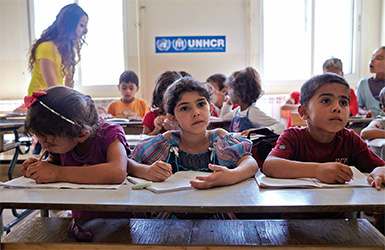
Syrian refugee children attend a make-shift school built by UNHCR. A large number of Syrian refugee children are not in school, despite efforts by governments and UN agencies
Finally, and perhaps most pressing, the Syrian crisis has underscored the fact that the vast majority of refugees in the world in 2015 come from Muslim-majority countries. The plight of Muslim refugees coinciding with the amplification of religious claims of violent extremists has produced counterproductive anti-Muslim rhetoric and a virulent reaction in much of the Western world against refugees as a whole. In education, this perceived ideological battle manifests itself in struggles over content and quality of textbooks in foreign aid-supported schools.
Although parents throughout the world are suspicious of outsiders who suggest what their children should be taught, refugee populations may be particularly sensitive since outsiders as well as insiders seek to influence and often manipulate them. History shows some suspicions were well-founded. For example, during the Soviet invasion of Afghanistan in the 1980s, the US government—to their chagrin today—funded the design and publication of textbooks called the Alphabet of Jihad Literacy. These books exhorted Muslim children to fight the Soviets, referring to it as their religious duty.
All of these tensions raise urgent research questions. Today, educators and policymakers want to understand the links between negative classroom practices and poor or biased textbooks and behavioral outcomes, to ensure that violent extremism is not promoted but rather diffused.
Yet despite these urgent research needs and calls to strengthen the evidence on which program decisions are based, rigorous research on education interventions and related topics remains scarce and diffuse, which makes it difficult for practitioners to find and apply up-to-date information in the field and difficult for scholars to build a body of knowledge and theory. Research on questions of critical importance to practitioners working in crisis-affected contexts, such as those related to access, funding, protection and quality, as well as research that illuminates the relationship between education and conflict, is especially limited.
In practice, the urgent requests for access to education from some of the most marginalized, remote, and conflict-affected communities in the world, should convince remaining skeptics that education is a real priority even in conditions of war or humanitarian emergency. People in these communities may be occupied with immediate survival, but that does not preclude them from looking toward a better day and a better future with equal urgency. Such a view toward the future is otherwise known as hope, and children’s education is an embodiment of hope.

Dana Burde is Associate Professor and Director of International Education at New York University, an affiliated faculty member at NYU Abu Dhabi, NYU Wagner School of Public Service, and the Saltzman Institute of War and Peace Studies at Columbia University. She is the author of Schools for Conflict or for Peace in Afghanistan, which recently won the Jackie Kirk Outstanding Book Award. She is also the Editor-in-Chief of the Journal on Education in Emergencies. Her research focuses on the effects of conflict on education, the efforts of humanitarian organizations to mitigate these effects, and the relationship between education and political violence or peace. Her research has also been published in Comparative Education Review, International Journal of Educational Development, American Economic Journal—Applied, Current Issues in Comparative Education, and the New York Times. Dana’s experiences as an aid worker and international education consultant include work in Latin America, Africa, and Central and South Asia. She has a PhD in Comparative Education and Political Science from Columbia University, an EdM from Harvard University and a BA in English from Oberlin College.